From AZC to DHL

Asylum seekers at work: this is how Timing, UWV, and DHL do it
The relaxation of rules makes it easier to help asylum seekers find work. Not surprisingly, there is increasing interest from employment agencies for this target group. How do you approach this in a good way? VoorWerk took a look at DHL Supply Chain in Nijmegen, where Timing has 12 asylum seekers working as warehouse operators.
Intercedent Daniëlle Wassenaar in conversation with the Syrian Baraa Aldroesh
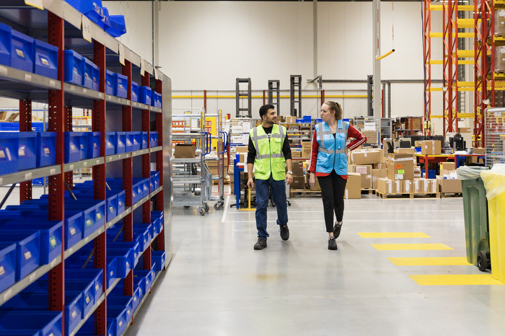
The idea to seriously work with asylum seekers arose about a year and a half ago with Estrella Gonzalez Canto, EMPower advisor at Timing. “For a long time, this group remained out of sight, mainly due to the complex application procedures for work permits (TWVs) and the risk of fines for incorrect procedures. With the relaxation of the rules (see box, ed.), that situation has changed. The opening of a new AZC in Dordrecht, near our client DHL, was the reason to look again at this target group: motivated people who are eager to get started.”
A year and a half later, Timing has helped 130 asylum seekers find work, 70 of whom are at DHL: the success of the pilot in Dordrecht was copied to other regions. Win-win-win: asylum seekers gain perspective and income, clients get motivated people, and society benefits from more participation. What does such a project involve? In a meeting room at DHL Supply Chain Nijmegen, 4 people sit around Estrella Gonzalez Canto: Jory Thunnissen, employer advisor at UWV, Elsemiek Tierney, HR business partner at DHL, Annemieke Camphens-Wouters, regional manager at Timing, and Daniëlle Wassenaar, in-house intercedent at DHL Timing.
Step 1: the exploration
Both Timing and DHL did not rush into this. Gonzalez Canto: “We thought carefully. What does this require from us? Who do we need? How does the application for a TWV work? What are the risks? And we started consulting with DHL: can we do this?”
Tierney: “We had just entered into a strategic partnership with Timing to tackle the shortage. This seemed like a solution. I listened to their experiences in Dordrecht and also conducted a risk analysis. It is important that permits are well arranged. Ultimately, we decided: we are going for it! This is the moment. What also played a role is that an AZC might also be coming near us in Nijmegen.”
Step 2: a solid plan
Gonzalez Canto: “We decided to start small and build up gradually. Within both Timing and DHL, we first sought broad commitment.” Tierney: “In the Netherlands, there are many prejudices about asylum seekers. Nevertheless, colleagues were quickly on board. There was a great need for new colleagues, which made everyone quickly align.” As a connector and driver, regional manager Annemiek Camphens-Wouters also played a role in this. “I ensure that the service is well rolled out. It starts with enthusing recruiters, intercedents, and clients. But also the collaboration with partners like COA and UWV is crucial. We already had connections with these parties from the pilot. I asked: ‘who do we need to be with?’ The answer was: ‘Jory.’
Step 3: Coordinating with COA
Jory Thunnissen: “As UWV, we had our own pilot running with COA and VNG to help more asylum seekers find work. Timing and DHL fit in very well here. What I am looking for are employers who are really open to this and willing to go the extra mile.” Camphens-Wouters: “In other parts of the country, we as an employment agency seek contact with the COA ourselves. But here in Nijmegen, Jory has completely taken that off our hands. Thunnissen: “From our national experience, we know that AZCs are approached by various employment agencies. And unfortunately, there are also cowboys among them. That’s why it seemed like a good idea to sit in between. I do a quality check to prevent asylum seekers from ending up with rogue employment agencies. Both asylum seekers who want to work and employment agencies that report to an AZC now come to me first.”
Relaxed legislation
- Abolition of the 24-week requirement
The maximum term of 24 weeks per year in which asylum seekers were allowed to work has been abolished. Since the end of 2023, asylum seekers with a valid work permit are allowed to work indefinitely as long as their asylum procedure is ongoing. This increases the possibilities for sustainable deployment and continuity. - Shortening of the waiting period for work (in preparation)
The current waiting period of 6 months before asylum seekers are allowed to work is expected to be shortened by June 1, 2026. Asylum seekers with a real chance of staying will then likely gain access to the labor market after 3 months.
Step 4: recruiting
The recruitment took place both online and physically at the 2 AZCs in Nijmegen. Thunnissen: “I am there at the work desks once every 2 to 3 weeks anyway. I speak to people who are looking for work, but I also answer questions from asylum seekers who are already working. Timing joined in a few times during the recruitment phase.” Gonzalez Canto: “Jory also came up with the idea to create a special landing page on our website for this project. A kind of online flyer with a QR code. Candidates can fill out a form via that QR code.”
This is how the candidates flowed in. Tierney: “In this phase, Timing and UWV were mainly in charge. They selected the candidates. We were – and are – mainly looking for people for logistical work, in the position of warehouse operator. The condition was that they have a reasonable command of English or Dutch and that they are motivated.”

Step 5: the selection and TWV application
The candidates had 2 intake interviews. One at the AZC and one with the in-house intercedent of Timing at DHL, Daniëlle Wassenaar. “Then it is also time to apply for a BSN number if they do not have one, and to start the TWV application. Estrella takes care of that. Gonzalez Canto: “It is a lot of paperwork, you should not underestimate it. And you have to think carefully about the job description and the number of hours you offer.” (see box ‘Legal tips’, ed.) UWV is then allowed a maximum of 5 weeks to process the application. Gonzalez Canto: “Usually we have a decision after 2, 3 weeks. So that’s not too bad.”
Legal tips
Alfer de Hollander, manager of legal affairs at Timing, emphasizes the importance of diligence. “With asylum seekers, it is extra important to establish identity correctly, because the fines for mistakes are high. The Foreign Nationals Employment Act also allows for other sanctions, ranging from a warning to the preventive shutdown of a company. We therefore use specialized software to thoroughly check identity documents.”
His most important tip about the TWV application: “You can apply for a TWV in a limited or broader way. With a limited application, you provide a very specific job description, a specific number of hours, and you name the client. But if you are looking for more flexibility, you provide a range. For example: this person will work 20 to 30 hours as a ‘general employee’. You can even omit the name of the hirer.” Isn’t that risky? “Choose what suits you and your hirer. It varies by region how UWV handles this, but generally, they are quite flexible due to the social importance.”
Another practical tip: “Secure the duration of a TWV in your company systems, so you can extend it in time. And note: a TWV is always valid for one specific bv.”
Step 6: final check
In the period between the application and the granting of the TWV, Timing keeps in touch with the candidates. Wassenaar: “We want to maintain the connection. This is these people’s first introduction to the Dutch labor market, so everything must go well. That is also why we do the contract signing physically with this group. We then provide information again or answer questions.”
The contract signing is also the time to check all documents once more: the BSN number, the BSN statement, the identity document, and the employment contract. Gonzalez Canto: “We also have our own checklist, which we go through completely again.”
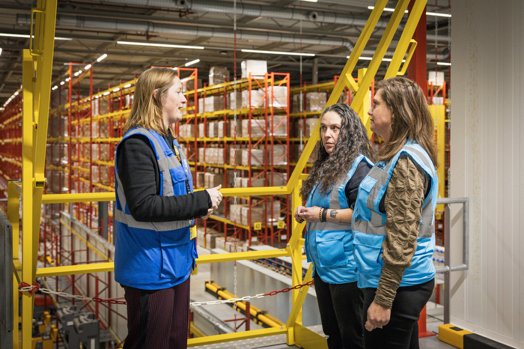
From left to right: Elsemieke Schipper (DHL), Estrella Gonzalez Canto (Timing), and Annemiek Camphens-Wouters (Timing)
Step 7: getting started
Time to really get to work. The asylum seekers go through the regular DHL onboarding process and start their logistical work. Tierney: “We only inform the relevant team leaders about the fact that their new employee is an asylum seeker. We are convinced that asylum seekers can be part of our workforce without being ‘labeled’. They are just a new colleague. However, we have learned lessons when it comes to employees with a war background. We have experienced that when the siren goes off on the first Monday of the month, someone could go into shock. That makes good guidance crucial.”
Step 8: and now?
The candidates are – just like other vulnerable workers – well monitored by Timing. Intercedent Wassenaar is almost literally on top of it in-house. Camphens-Wouters is satisfied: “It is going very well, also with the mutual cooperation. All parties are satisfied, and the asylum seekers perhaps the most. Some are highly educated and do work below their level. Yet they are very motivated. Anything is better than doing nothing all day. Moreover, DHL offers plenty of opportunities for growth.”
In the background, Gonzalez Canto also keeps a firm finger on the pulse. “I follow all 130 asylum seekers nationwide. We constantly look at: how is someone doing? Do we need to extend the contract and apply for a new TWV? Is someone ready for the next step?” Wassenaar: “Recently, one of the team leaders who initially had objections came to me. He said he took back his words and that the person in question was functioning well in his team.” It sounds like music to the ears of the ladies at Timing. Gonzalez Canto: “Our ambition now? To further expand this project across the country.” Camphens-Wouters: “And to focus more on growth opportunities.”
Source: ABU